Choosing the right traffic calming measure is rarely a straightforward exercise. Councils, transport engineers and contractors must weigh road classification, traffic volumes, pedestrian and cyclist vulnerability, emergency service access and budget constraints before committing to a scheme. Get it right, and the results are measurable: fewer collisions, lower vehicle speeds, and streets that support walking and cycling. Get it wrong, and you risk wasted expenditure, community opposition, or interventions that simply displace the problem elsewhere. This guide sets out the regulatory framework behind traffic calming in the UK, the main engineering categories available, how to assess a site before specifying anything, and how to evaluate whether a scheme has actually worked once it’s in the ground.
Understanding traffic calming: objectives and regulatory framework
Traffic calming refers to physical modifications made to roads and streets with the specific goal of reducing vehicle speeds, discouraging cut-through traffic, and improving safety for pedestrians, cyclists and other vulnerable road users. Unlike signage or enforcement alone, physical measures reshape how a road is perceived and used by drivers, encouraging consistent compliance rather than momentary caution.
Dft guidance and local transport note 1/07 compliance
In the UK, the Department for Transport’s LTN 1/07 Traffic Calming Guidance sets out the framework that local authorities and engineers work within. It covers vertical and horizontal interventions, surface treatments and shared space designs, and is the reference point most highway authorities use when justifying and designing a scheme. Any proposed measure should be checked against this guidance, alongside related documents such as Traffic Advisory Leaflet 7/96 (which specifies maximum hump heights of 100mm on roads with speed limits of 30 mph or less) and the Manual for Streets.
85th percentile speed and its role in scheme justification
The 85th percentile speed—the speed at or below which 85% of vehicles travel—is the key metric used in engineering analysis to justify and design a traffic calming scheme. Rather than relying on average speeds, which can mask a significant proportion of drivers travelling well above the limit, the 85th percentile gives a more realistic picture of prevailing driver behaviour. Speed surveys using automatic traffic counters over a continuous seven-day period are the standard method for establishing this baseline, alongside volume data by time of day. This data is essential both for identifying whether intervention is warranted and for setting measurable, SMART objectives, for example reducing 85th percentile speeds to 24 mph or below within a 20 mph zone.
Vehicle-activated signs versus physical interventions
Vehicle-activated signs and speed indicator devices remind drivers of the speed limit and give feedback on their current speed. They can be effective, particularly when paired with a reduced speed limit, but their long-term impact is less certain than that of physical measures. A raised table or chicane physically enforces the desired speed and space; a sign can only request compliance. For this reason, vehicle-activated signs tend to work best as a complementary measure or as a lower-cost option in trial schemes and rural settings where physical works are not yet feasible.
Section 90 and section 278 highways act 1980 considerations
Traffic calming works on the public highway are typically delivered under powers within the Highways Act 1980. Section 90 provisions allow highway authorities to construct traffic calming works on existing roads, while Section 278 agreements are commonly used where a developer or third party funds and delivers highway works, including calming measures, as part of a wider development. Understanding which route applies affects programme timescales, consultation requirements and funding responsibility, and should be established early in scheme development.
Categorising traffic calming measures by engineering approach
Traffic calming measures are generally grouped by their primary mechanism of action: vertical deflection, horizontal deflection, road narrowing and gateway treatments, surface texture modifications, and junction reconfiguration. Understanding these categories helps engineers match interventions to specific site constraints and objectives.
Vertical deflection: speed humps, speed cushions and speed tables
Vertical deflection measures create a raised feature on the carriageway to physically slow vehicles, and are among the most effective tools available, typically achieving speed reductions in the region of 5-15 mph depending on design and spacing.
- Speed humps are rounded or parabolic mounds spanning the full carriageway width, typically 75-100mm high and 3-4 metres long. They are best suited to residential streets and school zones but are less appropriate for bus routes or emergency response routes due to passenger discomfort, unless a sinusoidal profile is used.
- Speed cushions are raised sections installed in pairs or groups with gaps between them, allowing wide-axle vehicles such as buses and fire engines to straddle them while still slowing cars and motorcycles. They are the preferred solution on bus and emergency routes, though they are typically 2-3 mph less effective than full-width humps and can be uncomfortable for motorcyclists.
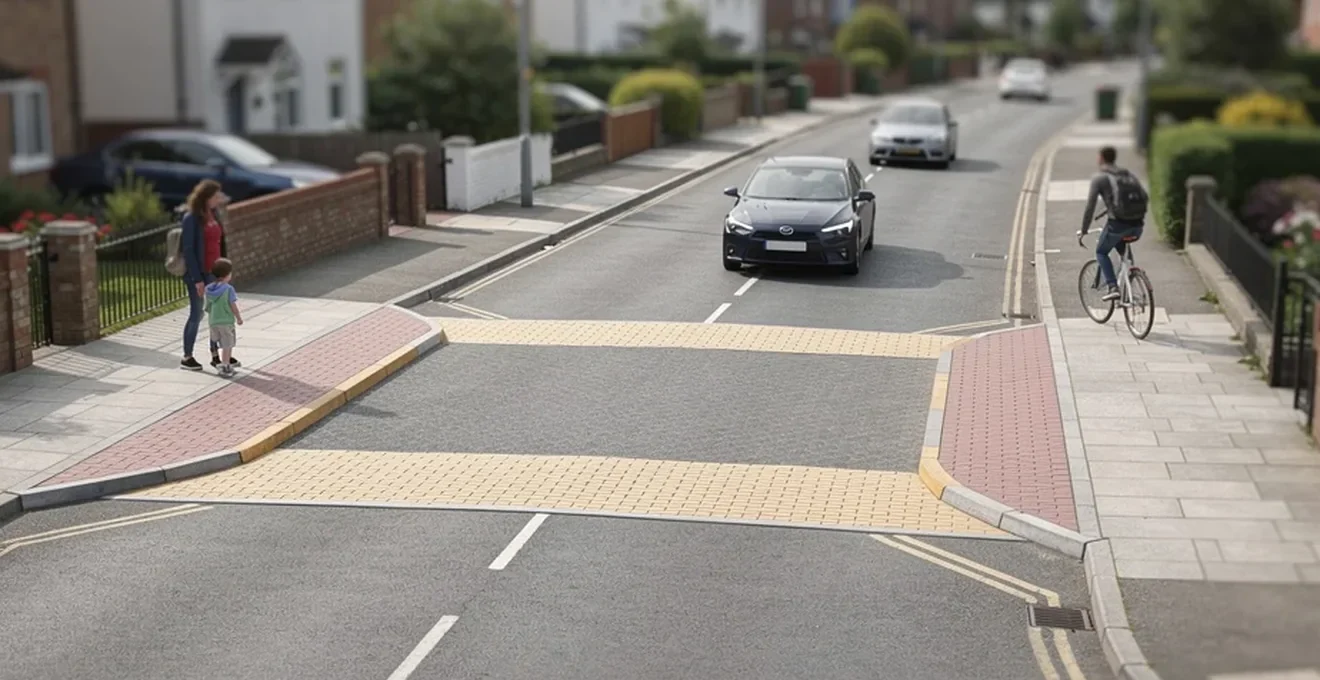
- Speed tables are elongated, flat-topped humps, usually 6-10 metres long with gentler ramp gradients of around 1:10 to 1:15. The extended flat section reduces passenger discomfort and noise, making them well suited to pedestrian crossing points, raised junctions and bus routes.
- Sinusoidal ramps offer a gentler profile than traditional cushions, remaining comfortable for cyclists, cargo bikes and emergency vehicles. Modular versions can be surface-mounted without excavation, using recycled materials, which supports both permanent and temporary installations.
Raised tables are also frequently used to create raised pedestrian crossings, combining speed reduction with improved pedestrian priority and accessibility. Research cited in DfT guidance shows that raised crossings can increase driver yielding rates from around 10% at uncontrolled crossings to 60-80%.
Horizontal deflection: chicanes, pinch points and Build-Outs
Where vertical measures alter the height of the driving surface, horizontal deflection measures affect the lateral path of travel. They are often preferred in town centres or narrow residential streets where physical elevation is unsuitable.
- Chicanes use alternating kerb extensions to create a serpentine path, typically with build-outs of 2.0-3.0 metres and an offset of 10-20 metres between them. They require adequate carriageway width (generally 6 metres or more) and work best on straight residential streets, offering opportunities for street greening as well.
- Pinch points and build-outs narrow the lane at specific locations, often to a single lane width of around 3.0-3.5 metres, requiring drivers to slow and give way to oncoming traffic. They are relatively inexpensive and can double as informal pedestrian crossing points.
- Choke points reduce a two-way street to a single lane, appropriate mainly for low-volume local streets, with care taken over cyclist provision.
By subtly shifting the driver’s route, horizontal deflection encourages alertness and reduces the likelihood of speeding. These measures are frequently combined with vertical interventions for site-sensitive installations that balance function and aesthetics.
Road narrowing and gateway treatments
Gateway treatments mark the transition into a lower-speed environment, typically at village entrances or the boundary of a 20 mph zone. They often combine speed limit signs, yellow backing boards and name plates with physical narrowing, central hatched markings or islands to separate opposing traffic. Side road entry treatments extend the footway across the mouth of a minor junction, using changes in surface material, raised carriageway level and kerb build-outs to emphasise pedestrian priority and signal the start of a low-speed zone. These are not recommended on high-speed roads, since turning vehicles need sufficient room to reduce speed safely.
Rumble strips and surface texture modifications
Rumble strips use closely spaced, shallow ridges—typically 5-15mm in height—to generate noise and vibration, alerting drivers to an approaching hazard or change in speed environment. They may be milled into existing asphalt, rolled in during surfacing, or applied as thermoplastic or prefabricated strips. Rumble strips function primarily as a warning device rather than a sustained speed control measure, and are best used at transition zones, such as motorway off-ramps, toll approaches or gateway treatments. Coloured surfacing, road markings and textured pavements—such as block paving or exposed aggregate—can reinforce the perception of a narrower or shared-use environment, though used alone they typically produce only modest speed reductions of 1-4 mph. They work best as a complement to physical measures rather than a substitute for them.
Mini-roundabouts and junction reconfiguration
Mini-roundabouts introduce circular geometry at junctions, requiring traffic to slow and circulate around a central island. Typical inscribed circle diameters range from 13-28 metres, with a central island of 1-4 metres, often domed and painted rather than raised. They are effective at four-way residential junctions with reasonably balanced flows and are associated with substantial reductions in severe right-angle collisions. However, they require adequate space, can confuse unfamiliar drivers, and are less suitable where pedestrian volumes are very high or flows are heavily imbalanced. Other junction treatments include tightening kerb radii to slow turning vehicles and shorten pedestrian crossing distances, and intersection realignment, which is particularly useful at T-junctions.
Site-specific diagnostic assessment before implementation
No single traffic calming measure suits every situation. Effective schemes begin with a thorough, evidence-based assessment of the site rather than a default reach for speed cushions.
Traffic volume data collection using ATC and MVC surveys
Automatic traffic counter (ATC) surveys should collect continuous data over a full week to capture mean speeds, 85th percentile speeds, speed distribution and traffic volume by time of day. Manual vehicle classification (MVC) surveys add detail on vehicle mix, which matters when assessing the likely impact on buses, HGVs and emergency vehicles. Together, this data establishes the baseline against which the success of any scheme will later be measured.
Road classification: distinguishing between A-Roads, B-Roads and residential streets
The function and classification of a road fundamentally shapes which measures are appropriate. A through-route carrying significant HGV or bus traffic demands a different approach to a quiet residential cul-de-sac. Key questions include whether the road is a through-route or access-only street, its statutory speed limit, whether it carries bus services or serves as an emergency response route, and its current traffic volume and composition.
Pedestrian and cyclist vulnerability mapping near schools and care homes
Understanding who uses the street, and how, is central to selecting the right intervention. This means assessing pedestrian volumes and demographics, including children, elderly residents and disabled users, cyclist volumes and skill levels, and the proximity of schools, care homes and other locations with concentrations of vulnerable road users. Sites near schools, for example, often justify raised crossings or speed tables specifically because of the exponential relationship between vehicle speed and pedestrian fatality risk: fatality risk rises steeply as speeds increase from 20 mph towards 30 mph and beyond, which is why school-adjacent streets are frequently prioritised for the most robust vertical deflection measures.
Emergency service access requirements and ambulance response times
Emergency services are statutory consultees for traffic calming schemes, and their operational needs must be built into the design from the outset rather than retrofitted. Speed cushions and speed tables with gentle gradients allow fire engines and ambulances to maintain reasonable progress, with well-designed cushions typically causing only a few seconds’ delay each. Aggressive full-width humps or speed bumps, by contrast, are generally unsuitable for routes used by emergency vehicles, buses or cyclists. Where an emergency response route runs through a traffic-calmed area, cushions or tables should be specified in preference to standard humps.
Matching measures to environmental and community contexts
Beyond the technical assessment, the right measure depends on the character of the area and the expectations of the community that uses it.
20mph zones versus 20mph limits in residential areas
A 20 mph zone is signed with an entry sign indicating both the speed limit and the presence of traffic calming features such as road humps and narrowings, which are not usually individually signed within the zone. Drivers are expected to adopt a steady, low speed throughout and avoid repeated acceleration and deceleration. A 20 mph limit, by contrast, can be applied without accompanying physical calming, relying instead on signage and driver compliance. Where a genuine, sustained reduction in speed is the objective, particularly on residential streets with vulnerable users, a zone incorporating physical measures is generally more effective than a limit alone.
Rural traffic calming: village gateways and interactive speed indicator devices
In rural settings, gateway treatments combining speed limit signs, yellow backing boards and village name plates are commonly used to mark the transition from open road to a lower-speed environment. Rumble devices, whether strips or larger textured areas, provide a visual, audible and vibratory warning ahead of a bend or junction, encouraging drivers to slow down without needing a specifically signed hazard. Interactive speed indicator devices, which display a driver’s actual speed, can reinforce these physical cues, particularly on approaches where a full engineering scheme is not yet justified or funded.
Urban high street solutions: shared space and Continental-Style crossings
In town centres and high streets, shared space designs reduce the dominance of motor vehicles, with drivers, cyclists and pedestrians expected to share the same street space. Motorists must drive slowly and be prepared to stop to let pedestrians and cyclists pass safely. Raised, flat-topped crossings integrated into speed tables are also common in these settings, removing the implicit priority given to vehicles and levelling the carriageway with the footway. These solutions work well where footfall is high and where a softer, more integrated approach to speed control is preferred over overtly engineered features.
Cost analysis and Long-Term maintenance planning
Budget realities shape which measures are feasible, and understanding whole-life costs is essential to avoid false economies.
Capital expenditure comparison across measure types
Costs vary considerably by measure type and construction method. Traditional asphalt speed humps and tables carry higher installation costs due to extended construction time and traffic management requirements, typically one to several days per feature. Modular, surface-mounted systems, including rubber and prefabricated designs, offer quicker installation, sometimes within hours, and are well suited to trial schemes or phased roll-outs where budgets need to stretch further. Rumble strips and surface treatments sit at the lower end of the cost scale but generally deliver a more limited speed reduction, in the range of a few miles per hour, rather than the sustained reductions achieved by vertical deflection.
Whole-life costing and resurfacing cycles
Material choice significantly affects total cost of ownership. Materials, weather resistance and drainage compatibility all influence how frequently a measure needs maintenance or replacement. Modular systems designed for durability can reduce long-term maintenance burdens compared with monolithic asphalt construction, which requires periodic resurfacing. When comparing options, authorities should weigh initial capital outlay against the expected service life and the disruption and cost of future repairs or resurfacing cycles.
Funding routes: section 106 contributions and local highway authority budgets
Traffic calming schemes are funded through a mix of sources. Section 106 planning obligations often fund calming measures associated with new development, where the impact of additional traffic needs to be mitigated. Local highway authority capital and revenue budgets fund area-wide or reactive schemes responding to community concerns or collision data. Given competing demands on these budgets, modular and phased approaches can help authorities trial interventions before committing to full-scale, permanent infrastructure.
Evaluating scheme effectiveness Post-Installation
A scheme’s value is only proven once it has been monitored against the objectives set before installation.
Before-and-after speed survey methodology
Repeat speed surveys, using the same methodology and, ideally, the same survey locations as the baseline, should be conducted at intervals after installation, commonly around three to six months and again at twelve months. Comparing 85th percentile speeds before and after implementation provides the clearest indication of whether a scheme has achieved its target speed reduction.
Collision data analysis using STATS19 records
STATS19 collision records provide the standard UK dataset for monitoring safety outcomes. Because collision frequency is subject to natural year-on-year variation, a monitoring period of three to five years is generally needed to draw statistically robust conclusions. This analysis should look at collision frequency and severity, the types of collisions occurring, and the involvement of vulnerable road users, comparing patterns before and after the scheme was introduced.
Noise and vibration impact on adjacent properties
Noise and vibration are common concerns raised by residents living near vertical deflection measures. Careful placement, avoiding locations directly outside bedroom windows where possible, combined with gentler profiles such as sinusoidal humps or speed tables, can minimise this impact. Much of the noise associated with humps arises from harsh braking and aggressive acceleration rather than the measure itself, and tends to diminish as drivers adjust their behaviour. Overall, well-designed schemes tend to reduce ambient noise levels in an area due to lower prevailing speeds, even if individual features generate a localised effect.
Community consultation and feedback mechanisms
Ongoing engagement does not end once a scheme is installed. Resident satisfaction surveys, perceived safety assessments, and monitoring of behaviour change, such as increased walking or cycling, all help authorities understand whether a scheme is meeting community expectations as well as technical targets. Structured feedback mechanisms, including public exhibitions, online surveys and targeted outreach to schools and disability groups, should be maintained so that concerns can be identified early and, where necessary, addressed through minor design adjustments rather than allowed to undermine confidence in the scheme.